
is there a difference between weed dependence and addiction? does it matter?
asking the hard-hitting questions no one wants to be asked :)

Three days before Christmas, I found myself on my knees on a patch of grass outside of an Alabama gas station, my arms holding my chest like a straight-jacket, chanting, “I can’t do this,” over and over again. I had just spent three days trapped in a car with my ex-fiancé, who was in the throes of weed-induced psychosis, something I didn’t know existed until it was screaming in my face. We had decided to do a “sober Christmas,” which solely meant taking a tolerance break because we ran out of weed and didn’t want to drive across state lines with it. We both smoked so much that we had stopped getting as high as we wanted— if at all. We were going to attempt Dry January, but I would not make it back to our life together. Instead, I would hit rock bottom after having a panic attack in that Alabama gas station. Then, I got sober.
There is cultural awareness and understanding when it comes to alcohol. If anyone called vodka their medicine after drinking around the clock, an intervention would be organized. However, weed doesn’t elicit the same alarm. This line of thinking isn’t about what we should do about marijuana but instead how we talk about it. When I was newly sober, I started all interactions by telling strangers and loved ones that I was a newly sober marijuana addict. My sobriety depended on that admission. Fragile and in active withdrawal, sweat so dank I still wreaked of bud, people responded, “But weed isn’t addictive.” But I knew better: I had lived it. I vomited daily after every bong rip, but forgot about it because I got stoned. And yet, people pushed back constantly.
Why don’t we feel the same alarm about weed? Of course, Cheech and Chong has more playful cultural resonance than Leaving Las Vegas, but I can assure you: I had my Leaving Las Vegas, Weed Edition.
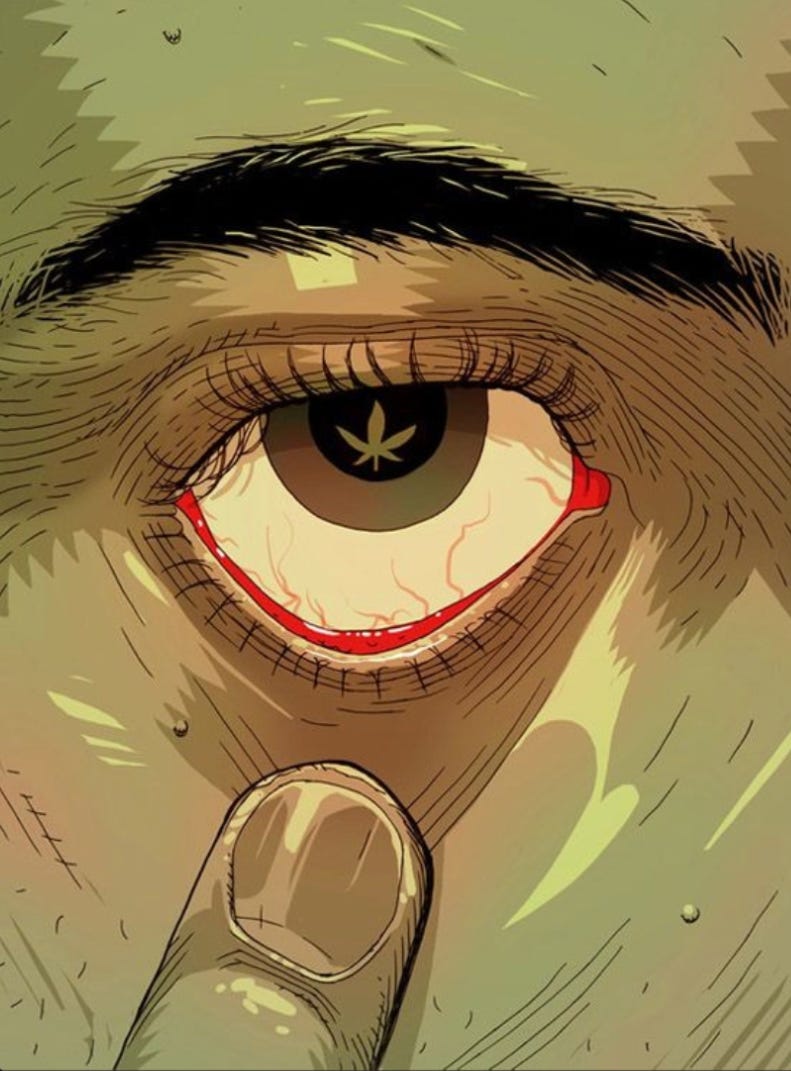
For so long, I would take a bong rip and hear the rhetoric that was used to legalize marijuana in my head: “Marijuana is non-addictive.” “Weed is natural.” Marijuana is medicinal.” And yet, as soon as I woke up, the thought of smoking bombarded my thinking. Try as I might, I could not shake the craving. Every day, I would end up stoned in the tub by 11 AM (which, unbeknownst to me, stopped the vomiting: I had cannabinoid hyperemesis, cyclical vomiting caused by my cannabinoid receptors being overwhelmed with daily use). Acircular thought with no end. I felt like I had to ingest it to function: to sleep, to eat, to write. To go to the market. And yet, when I did inevitably smoke, I lacked the capacity to function at all: I was so stoned all of the time that I confused the feeling of being high with being sober.
In the nineties, a joint started at 3% THC. Now, 13% THC. Dabs– a perfectly legal substance– are 80% THC and require a flame-torch to ingest its vapors. We are no longer smoking grandpa’s Woodstock weed– we are beyond ingesting a natural substance. We are taking weed to a meth-y degree, and yet we view it with equal measure.
Although I identify with the addiction framework, so often the framework of addiction can feel alienating. Pedantic, clinical. Plus, we have been told marijuana is not addictive for so long that it’s hard to hear the word “addiction” in the same sentence as weed. When I finally stopped, it was clear to me that I had an addiction: I could not stop smoking weed. I could not stop. While the delusion and distortion of addiction played its course, I had legalization rhetoric to condone my usage: I can’t be addicted because this substance is not addictive.
There is a difference between addiction and dependence. It is through assessing our relationship with the substance– whether or not we choose to stop– that we can decipher the distinction at all. And so many of us may be dependent without realizing it.
According to Stanford University neuroscientist and tenured professor, Dr. Andrew Hubberman produced a podcast about the effects of marijauna on the brain. In that podcast, I learned that a chronic marijuana user is someone who uses THC-related-products up to twice a week. However, that definition feels incredibly limiting– who only smokes twice a week? I certainly didn’t. Dependent on weed? You can stop. Addicted, you cannot.
Even without the full-manifestation of addiction, the ramifications of dependence are real: A full and varying spectrum of symptoms emerge from chronic usage, whether or not we quit: whether it’s a general feeling of inertia, mood instability, personality changes, panic attacks, depression, cannabinoid hyperemesis, or full-blown weed-induced psychosis. And still, it is easy to dismiss the weed. We point blame elsewhere: job stress, relationship strain, the state of the world. Weed becomes an easy answer: it’s easier to pack a bowl and disappear into the ether.
We all pay when someone we know is trapped in the delusion that weed is harmless. We all know someone— a family member, a family friend, a friend of a friend— who is so dependent on the substance but in complete denial that it is impacting them and the people around them. Who can’t get through a car ride without smoking a vape or asking mom to pull over so they can get out and smoke. I have had so many conversations with family members who feel relief in finally identifying: it’s the weed.They see it, but their weed dependent loved one cannot.
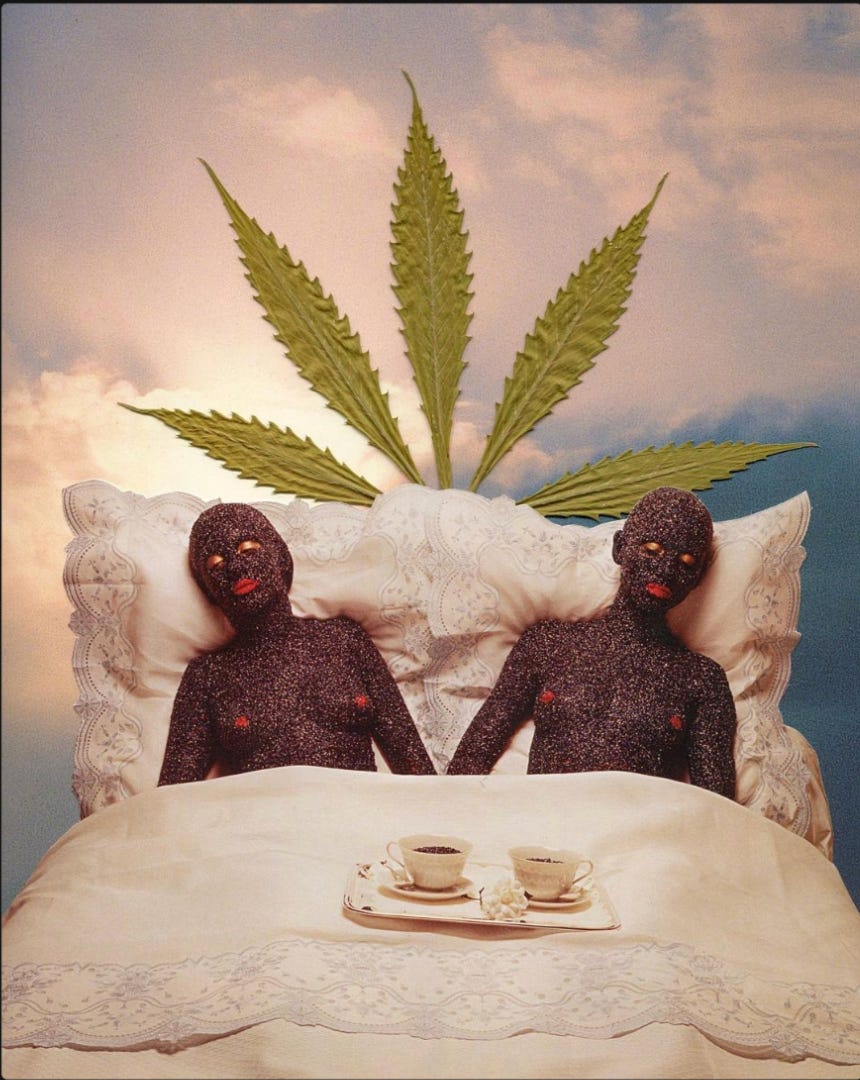
To be in love with marijuana is a beautiful love affair. First, it is fun. Lifting out of the monotony of the day-to-day; euphoric. Sexy. Perhaps even creative. But then, you find yourself grabbing for the joint or gummy or bong or dab, hoping for that same feeling. And sometimes you find it. But within time, the high doesn’t feel the same. The memory of it, a slippery illusion. The depression and anxiety when not high grow ever more disorienting; smoking to not feel anxious and depressed only making you more anxious and depressed. Paranoid: everyone hates me and can tell I was stoned. The minor inconveniences of life feel huge, massive. And inevitably, the 13% THC joint doesn’t cut it, and you find yourself driving from dispensary to dispensary, finding little pills that are 25 mg THC, having to take two to feel something: Obliterating yourself in the name of something you can’t remember.
The nature of addiction is that it is progressive, and I wish I had thought about weed as a substance on which I could be dependent. By the time I tried to stop, I could not: I lost five years of my life. But I wonder: if I had evaluated early enough, could I have? I have the grab-bag of genes that make me susceptible to addiction, a long-line of alcoholics in my family line a few generations back. Although their drug of choice was booze and mine was marijuana, I was still dependent on a substance just like them.
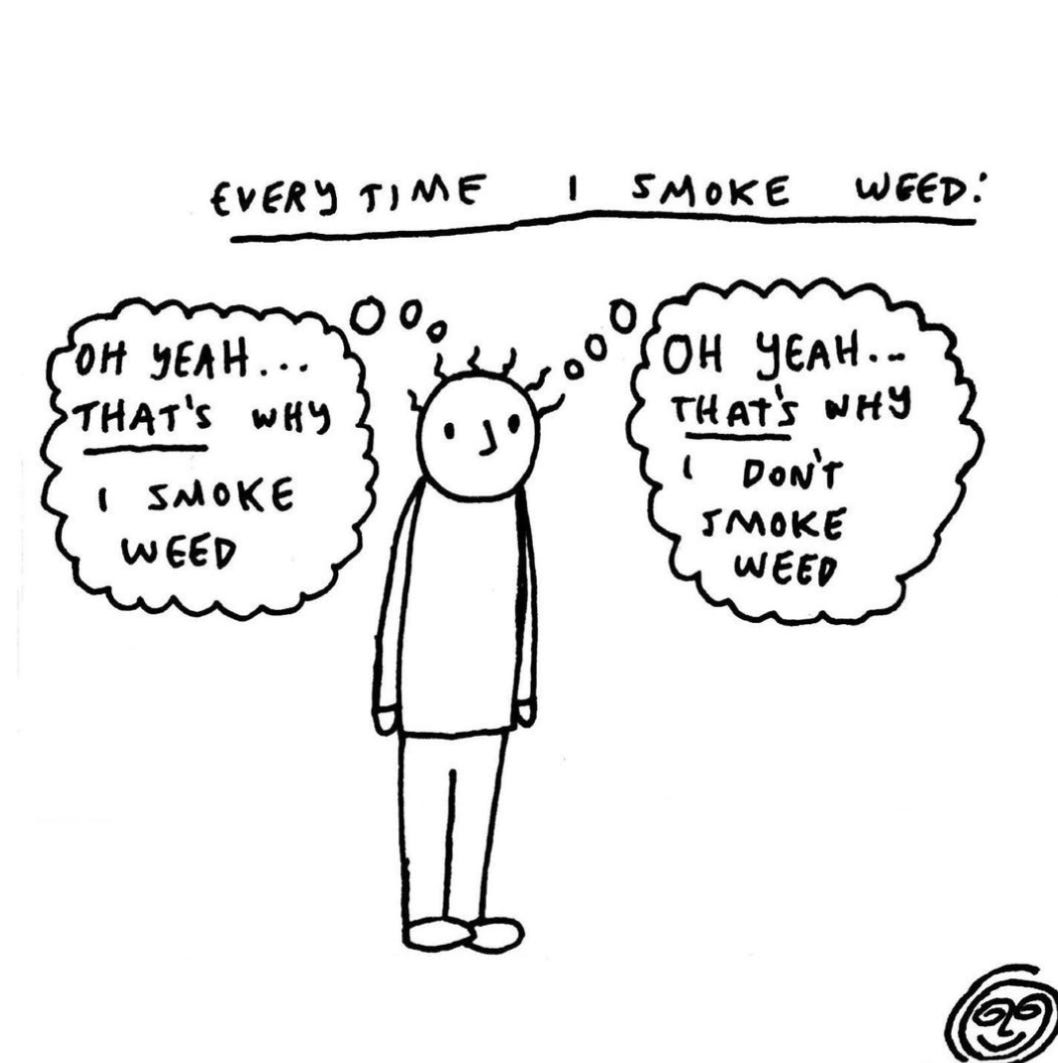
I was dependent on weed to connect or to isolate. To stop feeling a feeling or to amplify it. I needed weed to get myself to go to the market. To let myself think about something without feeling the pain of it. To eat. To sleep. To write. I used weed to tolerate being alone. Fear of running out, getting more before it’s too late– scraping the resin from a piece before inhaling dust. Sucking empty vape cartridges until something within it sparked, no doubt inhaling toxic fumes. And before I knew it, I was smoking for every reason under the sun, more than twice a week.
If I had been willing to question my dependence, maybe at one point I could have stopped before I was on my knees in an Alabama gas station three days before Christmas. Marijuana dependence does not have to progress to full-blown addiction if you’re willing to ask: am I dependent on weed? And if so, am I able to stop?
DAY 1618.
as always, thankful you are here. this is something i’ve been thinking about, long and hard, for a good long-while. eager to hear your response:
if you aren’t already, please subscribe:
almost had this piece run in The GIANT US newspaper, but it didn’t go because it didn’t “fit into the scheduling calendar.” le sigh. thankful for substack because you just hit PUBLISH and u r done.
THAT BEING SAID: VERY HAPPY TO WRITE ABOUT THIS FOR PUBLICATION wink WINK


Hi Paulina! Thanks as always for your timely thoughts. I have been in the grips of marijuana dependence for several years, really since COVID. You definitely nailed the push and pull of - yay this is fun in the moment but also derails lots of other things - I tend to stay up later, eat more junk, get glued to screens, etc., and then feel sluggish and lazy and foggy the morning after. I know for me it's never a cold turkey thing - very plus and minus, back and forth, forward and backward.
Powerful. Thank you.